Something that I admired while reading Dictee was Cha’s adoption and claim of the obscure. What someone brought up while we discussed Glissant’s work in my small group last week was how one way an author can choose to claim obscurity is by refusing to translate their writing. Cha does in several instances, at different times refusing to transcribe the English translation of French, Chinese, and Korean. This obscurity is further supported by the continual denial of explanation pertaining to the meaning of passages specifically due to the fragmented syntax, playing with the difficulty of language and speech, specifically emphasizing the lack of it. Throughout the entirety of the book, I felt she was exercising her right to be obscure, to experiment with writing and language, and not submit to the pressure of needing to explain the meaning. This obscurity abetted her thematic ponderings of transgenerational trauma and historical violence and loss, specifically through the lens of the Japanese occupation of Korea. Her, at times, ambiguous lines and syntax especially highlight the displacement and loss of identity Cha is experiencing and working to articulate. The fragments work as exemplifying the struggle of language and the ways in which she dealt with struggling to connect with her “identity” as a young Korean girl, and then woman, in America.
All this to say I honestly struggled with the obscurity of her work often in this reading. I mean often. I found myself rereading the same line multiple times, only to occasionally admit defeat and decide to move on. Sometimes reading further would help in my decoding of the previous line, in others, it did not. Despite my continual melees with the text, I did enjoy it. I enjoyed her imagery, use of Greek mythology and historical analogy (sigh as I admit to having Percy Jackson imprinted on me from a young age, therefore, the mere mention of Greek mythology is of utmost interest), and experimental syntax. In my project I hope to draw inspiration from her use of syntax in exploring the conversion of thought to speech, the difficulties in this, what the language we use in doing this represents, and the lessons in the silence or absence of speech.
Inserted is a rough rough rough brainstorm of questions to suffer through [as I did]
– Do I sound sane? If someone else could peel back the roof of my skull, rip off the hinges of my calvaria, and watch my consciousness stream like a shitty Netflix original, would they think I was mad? Am I only as rational— lucid— coherent— stable as the words that I vomit?
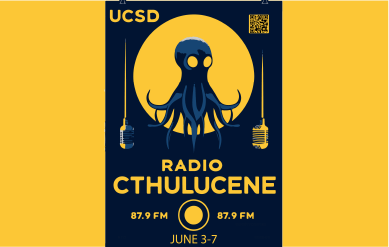
 Radio Chthulucene 87.9 FM
Leave a comment