Attempting to understand TwERK has been a vast undertaking. And after reading and analyzing many of the poems, consulting the notes at the end of the book, and discussing Diggs’ work in class, I can report that I feel almost nowhere near a complete sense of understanding.
But I feel fine about this; in many ways, I don’t think Diggs intended the book to be completely understood. I’m finding that TwERK (and previously Dictee) are helping to give me a permission I’ve been denying myself for years with my writing: the permission to not consider the audience.
When writing I often find myself consumed by thoughts of the audience. Usually I try to imagine how the work would be received by somebody who doesn’t know me. Or by the people in whatever class it’s for. It affects what imagery I lean into, the diction, the form, the level of experimentation, the vulnerability of the piece, etc. And it’s honestly quite difficult to get anything down when my sights are set on a public response.
However, Diggs and Cha have both started to hack away at this notion. Neither of them are interested in convincing the reader of the merit of their work; they simply write what they want to say.
If Diggs referenced pop culture elements that every reader would understand, TwERK would lose much of its mystique. If Diggs or Cha had written their books entirely in English, yes, they would be more easily digestible, but so much of their artistic merit would fall away, as well.
The strength of these texts rests in their ability to provoke thought. And if a work is easy to consume, perfectly intelligible, and right on the nose, it fails to provoke thought.
My project will probably not make sense to many people on first read/listen. And while I previously believed this to be a weakness, I am now actually pleased with this fact. It’s not that I want the audience to struggle; but I think I may have been going a bit too easy on the reader before. TwERK has opened my eyes to a whole new kind of poetry.
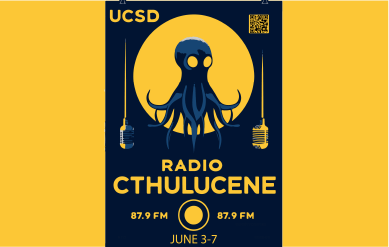
 Radio Chthulucene 87.9 FM
Leave a comment