I am shortening my workshop piece. With this comes the heart-wrenching process of cutting runt motifs, stillwater symbolism, out of the story. I really enjoyed Cog•nate Collective’s visit to our class. Amidst all the good information they were dispensing, I really latched onto 2 ideas, which are honestly more so phrases than anything:
- Intimate language— The language spoken with those one is closest to. I’ve never really thought about language in this way, though I sometimes wonder about my relationship with Mandarin, and often explore permutations/ways of understanding and being able/unable to translate my own name in my work
- I want to funnel all the motifs in my story into this idea of naming/having a name that resists Anglo-normative understandings of closure, as it comes to translation
- In this same sense, I wonder if Mandarin constitutes an intimate language for me– I do use it in private conversations, I am fluent, and I speak it with my parents and my relatives. On the other hand, I think it is in the process of attempting to translate my own name to English– not any product that I come up with, but the act, the ways in which I struggle for any definition that can provide security and closure– that I find highly intimate, highly resonant with my positionality in America.
- What is intimacy if not closeness, if not proximity with my being?
- In this same sense, I wonder if Mandarin constitutes an intimate language for me– I do use it in private conversations, I am fluent, and I speak it with my parents and my relatives. On the other hand, I think it is in the process of attempting to translate my own name to English– not any product that I come up with, but the act, the ways in which I struggle for any definition that can provide security and closure– that I find highly intimate, highly resonant with my positionality in America.
- With that being said, naming needs to be brought into the forefront of the story– that means, I should probably explicitly introduce it earlier, at least around where I’d provide the analysis of the phrase “The Heart of the Silicon Valley”
- I want to funnel all the motifs in my story into this idea of naming/having a name that resists Anglo-normative understandings of closure, as it comes to translation
- Expropriation— The act of dispossession; the state taking land away from certain people. My mind jumps to contrast this with the idea of the intimate language, which comes from a proximity that is very much personal/internal; however, I know the boundaries between physical land and inner life/identity are tightly conjoined
- Thematically, anytime I describe setting in my piece, it must relate– symbolically or otherwise– back to the construction of the Chinese American identity (or lack thereof; I could not pinpoint what it means to be Chinese American if you asked me. My parents are first-generation immigrants, who chose to plant us in the San Jose suburbs; it feels like we have never had a chance to root)
- Even this idea of a forced blankness funnels back into expropriation– who had to be erased for these suburbs to exist? Whose families are being legislated out of this increasingly expensive city? From the beginning, upon moving to America on H-1Bs and F-1s to work in tech, we have already been inserted into these systems of displacement, these institutions of harm.
- Expropriation sounds like appropriation– I think of the blankness my specific upbringing, compounded with my ethnic/racial identity, has given to me; a sort of blankness we have appropriated from, and that we sometimes mistake for whiteness. I know many Chinese Americans who aspire for whiteness without understanding that they are aspiring for whiteness.
- To write about my own name is to remind myself that this crossover from Chinese to white is not only undesirable, but impossible given the broader structures of imperialism and racism we feed into knowingly/unknowingly
- Thematically, anytime I describe setting in my piece, it must relate– symbolically or otherwise– back to the construction of the Chinese American identity (or lack thereof; I could not pinpoint what it means to be Chinese American if you asked me. My parents are first-generation immigrants, who chose to plant us in the San Jose suburbs; it feels like we have never had a chance to root)
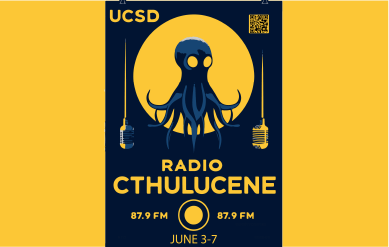
 Radio Chthulucene 87.9 FM
Leave a comment