My father is an avid surfer, who frequently partied at Rosario Beach in his youth; he still enjoys Tijuana’s rich cultural and culinary landscape on his way to the Valle de Guadalupe, where he purchases cases of wine. Mexican wine is underrated, he says. When I was younger, he often brought me along to play translator, though my Spanish wasn’t (and still isn’t) very good. I crossed the U.S.-Mexico border many times before I was old or cognizant enough to understand the concept of borders. Years later, my ex-boyfriend and I would visit his extended family just south of the San Ysidro crossing. My fluency increased; his bilingual friends graciously allowed me to stumble over Spanish phrases, cheeks burning red with social anxiety and Tamarindo Smirnoff. It is an immense privilege to learn a second language out of desire, not necessity. It is an immense privilege to slowly inch back toward the border crossing without doubting one’s safe, unhindered passage between two nations, without understanding what “nation” really means.
I am interested in cog•nate collective’s traveling radio project: street vendors and drivers alike hear the same broadcast, advertised via automobile. Sonic space crosses boundaries between bodies, cars, and nations. The artists also invite passers-by to read anonymous migrant testimonies, allowing space for the imaginative processes of memory in recounting traumatic experiences. Here, I am reminded of Karla Cornejo Villavicencio’s The Undocumented Americans, a collection of memoiristic essays. In crafting a nuanced, authentic portrait of the undocumented experience, Cornejo Villavicencio fiercely protects her interviewees’ safety without sacrificing journalistic rigor (or humor, or emotion). I am also reminded of Emiliano Monge’s Among the Lost, an intriguing and deeply disturbing novel. Monge fictionalizes migrant testimony to examine the processes of dehumanization at various levels of a large-scale trafficking ring. Each project is a testament to art’s ability to preserve memory, engender empathy, and even generate action in expansive, interactive ways.
This week, I attended the final New Writing Series event of spring quarter. Two of my Instructional Assistants, Olga Petrus and Alexis Aceves-Garcia, read from their theses. The graduates collectively withheld their readings from UC San Diego’s poetry archive in a gesture of solidarity with the Palestinian people and student protestors. The final “reading,”—or rather, performance-activity-thing—called upon audience members to confront their own complicity in genocide, to recognize the immense privilege of creating and consuming artistic products within the university’s walls. Whether creative self-expression is itself an action or merely a catalyst, the onus of tangible change rests on each of our shoulders.
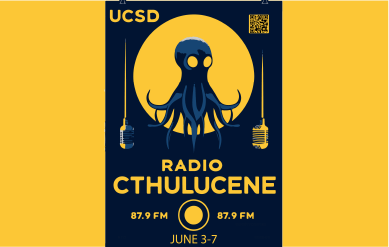
 Radio Chthulucene 87.9 FM
Leave a comment