Oh wow, recording things sucks. I was expecting the process to be difficult, but I think I severely underestimated how long it would take me to learn what all the different vocal effects on a generic sound editing app/software meant (what is wet/dry grain? Why does this app charge me money to save my audio file?)
Things that happened this past week(ish, because I keep turning things in late)
- I went to the MFA reading, which was a moving and exceptionally powerful experience. I liked this idea of the Black Hole in the Digital Archives that the third-year MFA students wanted to leave– effective use of emptiness (lack of recording) to critique emptiness (lack of action against genocide)
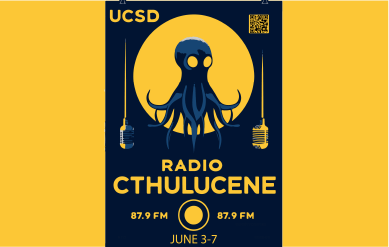
- Interestingly enough, attending this event also directly led to me being able to secure my radio location. Thank you, Ricardo (and thank you, Professor Amy, for connecting us)
- While putting the audio for my piece together, I realized:
- There is background noise everywhere in my apartment (it doesn’t help that I live right beside a six-lane expressway and a private school that regularly hosts rallies where they blast “Eye of the Tiger” on repeat at random hours)
- This realization also led me to learn about the concept of room tone, which is the ambient noise in a room that filmmakers record at the filming location for any given scene. Room tone plays behind any post-production dialogue, so the audio feels like it was said live, rather than dubbed over later
- The software I was using threatened to make me pay for a year-long subscription to get rid of any room tone/background noise– filmmakers and I were seeking two very different things
- This realization also led me to learn about the concept of room tone, which is the ambient noise in a room that filmmakers record at the filming location for any given scene. Room tone plays behind any post-production dialogue, so the audio feels like it was said live, rather than dubbed over later
- I would not add any background music/sfx to my recording
- The piece is inherently auditorily cluttered even without any additional effects, because the listener needs to keep track of the continuity of the frontstory while long endnotes interject every few sentences
- There is background noise everywhere in my apartment (it doesn’t help that I live right beside a six-lane expressway and a private school that regularly hosts rallies where they blast “Eye of the Tiger” on repeat at random hours)
- For my written piece, I changed all the random numbers that people didn’t think correlated with anything into superscripts. It reads with (hopefully) a lot more visual clarity now
- I had considered including more Mandarin in the frontstory, but decided against it after thinking about a brief exchange Professor Hoang and I had about “Broccoli” (and then reading this excerpt from “Broccoli”)
- iirc, Hoang said that she thought the Vietnamese half, “BÔNG CAI XANH,” flowed a lot better than the English half, though broadly the two sides were telling the same story
- She said that there were just some nuances that couldn’t be properly carried over, and that all attempts at translation were just going to have this sort of element to it; a sort of emptiness (refer to references to emptiness above), a kind of leaving out as the two sides switch
- I like the idea of leaving Chinese out of the frontstory– having it purposefully be a dry, forced conversation between two people who have clearly outgrown one another.
- The frontstory’s dryness comes because thematically, it’s a conversation about adhering to capitalistic individualism and a kind of encouraged complicity as it comes to working within the American military industrial complex (that academic institutions and the rest of our culture at large fosters)
- In this sort of setting, to speak Chinese almost feels taboo– the whole perpetual foreigner, fight for global hegemony, etc. etc.
- I wanted the one-noteness of the front story to be palpable, as contrasted with the more personal, Chinese-culturally tapped-in endnotes
- The translation between the two ‘halves’– frontstory and endnotes– is just as much about the transferring from a sort of forced tabula-rasa, American Dream mentality into the context/culture/history that the characters try to deny, but ends up following them anyways
- The frontstory’s dryness comes because thematically, it’s a conversation about adhering to capitalistic individualism and a kind of encouraged complicity as it comes to working within the American military industrial complex (that academic institutions and the rest of our culture at large fosters)
- iirc, Hoang said that she thought the Vietnamese half, “BÔNG CAI XANH,” flowed a lot better than the English half, though broadly the two sides were telling the same story
 Radio Chthulucene 87.9 FM
Leave a comment