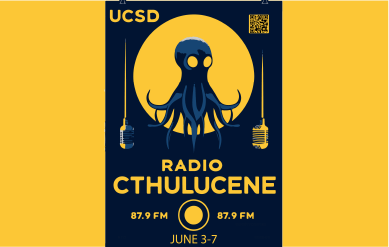
Well, I installed my radio! It took a bit of trial and error to find the right spot within the region I was searching, but eventually I found a landing of the stairwell that had a working outlet and positioned it there. Also, at the request of the psychology department chair, I provided a sign explaining what the radio is.
On the sign I also put a QR code, which links to the first poem in the collection (“FAMILY TREE”), so that listeners are able to engage with a visual element, as well. Since I care so much about how the work looks on the page, I wanted that to remain accessible in some form. However, I opted not to link the entire project. I still believe there is a lot of work to be done on the piece, and anyway, I don’t want all of it in the hands of any random passerby with a QR code-reading phone.
Our last class was quite special. Funny how Lily Hoang is mentioned in two of my journal entries now. Her piece “Broccoli,” written in collaboration with Vi Khi Nao, is a stunning example of the lengths to which writers can engage in cross-language play. I’m fascinated by the puns and wordplay that Hoang alluded to in our discussion, and kick myself for not being able to understand the work to its fullest extent. As frustrating as that may be, though, it is a testament to the piece’s opaqueness; only a certain few are able to see through it completely.
I’ve recently started dabbling again in short fiction writing. I really only work in poetry most of the time. Here and there I will begin to write stories or memoirish things, but I never like them enough to come back to them. “Broccoli” made me begin to reconsider my fear of the form, though. The piece is so brief and spectacularly mundane that it caused me to realize how overly seriously I’ve been taking story-writing the past few years.
Sometimes a story is nothing more than a slice of life. “Broccoli” is quite dialogue-heavy and driven forward by its two characters, hardly at all by a plot engine. It reminds me vaguely of Hemingway’s “Hills Like White Elephants,” which is almost entirely dialogue, full of brevity, but tells a story just the same. It’s amazing, and it lends itself quite well to the types of stories I want to be telling. I wish I had thought about it sooner.
 Radio Chthulucene 87.9 FM
Leave a comment