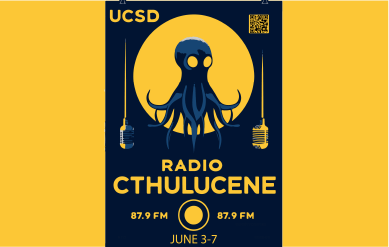
Today, we concluded our LTWR 113 course with a walking tour of our peers’ radio stations. While many of them (mine included) did not work properly—“radio silence”—it was enjoyable all the same to explore various new locations on campus and learn about their respective impacts on each of our lives. I discovered new corners of the Old Student Center and walked to the very edge of campus in Revelle. And some of the radios did function; and it was exciting to stumble upon noise where you least expect it, seemingly playing from nothing, like unzipping thin air and stepping inside of it.
Although my project did not play aloud, it is still very real. The radio may not have worked but the audio exists all the same, as does the written version, and I am proud to have completed them, though I wish I could have heard it play in the intended location. The McGill stairwell is a site with rich artistic history, though, so I am proud to have left a mark on the space, fleeting or not. Like I said in my piece, I am part of a great tradition.
Completing this project was a feat of strength. I’ve never worked on something over as long a period of time as I worked on this, nor have I ever felt so vulnerable in a piece of work, and it became fatiguing at a certain point to delve into the subject matter. What I submitted for workshop was really only half of the story; I had only written the introduction “FAMILY TREE,” the conclusion “INTERSTICE,” and the “MOTHER” and “FATHER” sections by this point. It was four of the six parts, but it lacked two key perspectives: “TOP” and “BOTTOM.” The latter required an engagement with feelings of shame and self-pity that was uncomfortable to broach. But given that this section represents a loss of power I felt justified in the expression of my feelings. It is degradation—being degraded. It felt strange to write, but it didn’t trouble me like “TOP” did. This section, on the other hand, is an exercise of power. It, too, is degradation—to degrade. To be degrading. As I think is clear from the project as a whole, I resent the patriarchal spirit that’s caused such a great divide between the sexual giver and the sexual receiver. Writing “TOP” I found myself feeling ashamed of the many similarities between myself and my father, feelings I regularly repress. In short, writing this project felt, in some ways, a bit embarrassing.
I think that’s to be expected, though. Exposing myself through this work was necessary, and liberating, but likely to be tough when the content is so emotional. It may not seem like an emotional piece, and the subject matter might not even seem worthy of such emotion. But I find it ineffably depressing that our current generation is growing up without the role models it deserves. A staggering number of members of the LGBTQ community died during the AIDS crisis and, as a result, this enormous body of queer youth is coming of age with our parents’ heterosexual relationships as the blueprint for love. And it’s all wrong; it’s heartbreaking.
So while I had so much difficulty finishing things up, I am proud of having started to say what I’ve wanted to say for so long. I think the product is a scratch on the surface. I don’t loathe my output, but I am definitely not satisfied, either. I think the piece has a few high highs, but suffers from many low lows. The parts I find the strongest are “FAMILY TREE” and “INTERSTICE.” Contemplating now, I wonder if that’s simply because these are the sections that were written the most traditionally. I struggled the least with their inceptions and executions and the forms came rather naturally. “FAMILY TREE” feels like a gentle jumping-off point for what’s to come, what with its engagement with gender and pronouns; its themes of family, domination, and subordination; and its mild play with form and aesthetics. These (in addition to it being the collection’s introduction) are the reasons I chose to include a link to only this poem at my radio station: it is a good place to start. On the other hand, “INTERSTICE” hardly plays with form; it is simply a poem, but I think it ties the collection together well. It touches on each of the project’s key perspectives, either covertly or outright, and hearkens back to the themes of sex, split identity, incomplete understanding, and resignation which bind the project together: it is a good summary.
The weaknesses I find in this collection are manifold. It would be superfluous to mention many of them. As I said, this work barely scratches the surface; there is so much further I could have, and should have, and will take this project. The parallels between “MOTHER” and “BOTTOM” and, separately, “FATHER” and “TOP” are awkward and incomplete. The former pair fails to adequately express the experience of subjugation and expectation associated with each of these roles. Neither does the latter pair properly explore the origins or persistence of their dominion. There are through lines to be etched and countless opportunities for symmetry to be employed, which would better establish the point I am trying to make. In general, I guess I really have one overarching complaint about this project: it does not make clear my point. The takeaways are still too vague, the connections not yet thought through thoroughly enough.
All is not lost though, thankfully, because I do plan to continue working on this project. I don’t expect that much of it will survive the level of radical revision which I am envisioning, but that’s okay. I think what I really need is more time and, while this is the longest I’ve consistently worked at a project, it still was not long enough for my ideas to simmer completely. But I know that, because this is a topic I care so deeply about, I will come back to it. I have such a love for my community and have such an innate appreciation for the queer trailblazers who came before me that I think it is actually a project I have no choice but to see through. Next year I plan to take the capstone for writing majors, and I think this project might be an excellent starting point for a much larger piece of work. Undoubtedly it will involve a great deal of expansion, but I’d like to maintain many of the experimental aspects of the writing, as well as possibly the title and the thematic separations that come with it.
I imagine in a future iteration the “MOTHER,” “FATHER,” “BOTTOM,” and “TOP” sections could each be divided into many separate pieces, focusing more closely on minutiae or specifics, rather than the broad scope they aim to cover now. In this version, the collection is much longer than six parts, but still revolves around the four major perspectives at work. In this version, the poetry might be narrative, or linear in some way, and bounce between each perspective. In this version, there could be a chronological order to the poems, but also thematically distinct “families” of poems, as well, which are distinguished by voice, setting, character, or some visual aspect. I’m not sure how this would end up looking, or how it would work, but it’s what comes to mind when I consider the future directions of the project.
Overall I am proud to have been a part of this fascinating collaboration between the Visual Arts department and ours; Radio Chthulucene is a prime example of the artistic innovation happening right now at UC San Diego. I’m excited to be coming away from this course with many pages of new writing and many minutes of audio to go with it, and I look forward to seeing what future endeavors these could lead to. Thanks Professor Carroll for a great quarter!


 Radio Chthulucene 87.9 FM
Leave a comment