I have been reflecting a lot on my radio project and how much my perspective and priorities have changed since I wrote the first draft of my piece.
I had initially started with an alternate project that aimed to address or retell the Dutch segregated schools in some way. Every time I try to write about this topic, it never goes well because of my personal history with it. After two attempts at starting over, I had a breakdown at Geisel and decided this was just not the right time.
Therefore, “traduttore, traditore,” initially titled “It doesn’t translate,” was born at nine p.m., a mere three hours before the workshop submission deadline. Texts were sent. Parents were called. Time zones were ignored. Along with the people I kept close in my life, I thumbed through Reddit threads exploring terms of endearments in languages I had heard growing up to see if any words were ones that were said to me.
A part of me loves this project. A part of me loathes it. She is like a child I would imagine being raised by a village: eccentric, a little awkward, and trying to please too many people at once. I may have given birth to her, but she is no longer mine.
I lost interest in her during her teenage years. By her teenage years, I mean weeks four through six of the quarter. The neglect made her spiteful, so more parents from the village of languages took her on.
I was no longer concerned with this celebration of language; my work did not feel “relevant” to the work I was doing outside of the classroom. It is a hard mentality to explain, but ultimately, I was no longer motivated by this project because I was distracted by— what I deemed to be— more pressing issues.
However, transferring the written word to audio form renewed my interest. This became one of the piece’s strengths—with Professor Amy Carroll’s guidance, I was able to add the sound of my cat purring and chants from the Palestinian protest as different language forms. During this process, I was also able to think more closely about revisions that came up during the workshop.
The previous title, “It doesn’t translate,” attempted to address one of the complications of translation, especially when translating into English as this project did. In this procedure, the complexities of a word—including the emotional connotations—become lost. Therefore, I decided to go with “traduttore, traditore” instead. Not only did it add to the variety of languages used in the piece, but the Italian to English literally translated to “translator, traitor.” The saying refers to the betrayal translators commit when translating words from one language to another and all the cultural contexts that are forgotten in the process. I felt I was doing this, even while trying to capture the contexts in which I have experienced each word: being a traitor. I could revise this piece for years, and it will never pay proper homage to the original language when taken into English. Although this is a flaw, the self-awareness through the title could be interpreted as a strength.
Another limit of this piece was the translation into English itself. Each translator was united by their shared knowledge of English and by also having to codeswitch to English in their everyday lives; therefore, I had made the decision for this to be the unifying language one translates to. While there were instances when a translator moved between more than two languages, such as “motu/golu” being likened to the Spanish “gordita/gordita.” This came from the limits of our translators, who often only knew English next to their native tongue.
A conflicting feature of this project was trying to create an inclusive environment for the audience regarding gendered words without overstepping on a translator’s creative liberties. This was not a struggle when I was translating Azerbaijani or Farsi, which are not gendered languages and nor do they use pronouns. However, as I was working with a native Spanish speaker, Ana Cardenas, we discussed the limitations of including “e/x” endings in addition to the binary “o/a.” She mentioned that she had never encountered these endings in use; thus, we faced a dilemma. I did not want to falsify her experience with these terms because the personal attachment to the endearment terms was an essential aspect of this project. Yet, should we risk making those who do not conform to the gender binaries feel unincluded in the project?
Finally, I decided not to overstep and leave it up to her. I would argue that the gendered language is a weakness in the project, but there were strengths in the collaboration. In its audio form, each section is read by its translator. Thus, each word is correctly pronounced, and the auditory form includes a voice that is emotionally connected to the word. It would not have been the same if there was only one voice reading each language that occupied the piece.
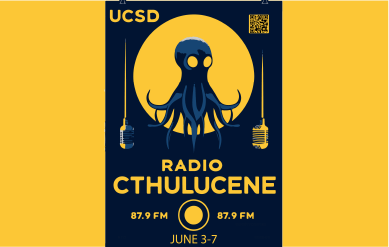
The variety of voices led me to also accept the location the radio station eventually ended up inhabiting: John’s Market at 32.87845° N, 117.24235° W. Initially, I had hoped it to be near Audrey’s Café, but after battling both managements, Lisa Joy was able to offer me a spot in the market’s back office (thank you, Lisa). I like the idea of my station being tucked away from sight; she can be found if one listens for the right thing, tuned to the specific station.
This is similar to the feeling of being an immigrant or the child of immigrants, where one is looking for a kindred understanding through language. Even though each translator was from a different country, there was an unnamed insight into codeswitching between English and one’s native language. We all lived through this experience of being stuck in the in-between of cultures— which was represented in “traduttore, traditore” through language. Similarly, the radio station lives in an in-between space. She’s in a working office that customers cannot reach, even if she’s technically in John’s Market. This parallels how our minds are thinking through an alternative language even while existing in an English-dominated space.
While it was a stressful process, I am glad the station discovered an unexpected home in time for the exhibition. It also reflected the uncomfortableness of translation or the feeling of being out of place in the English language, which reflected the station’s physical space.
Last week, I was near the library when another student started conversing with a friend and me. We were all born in different countries: Afghanistan, Azerbaijan, and Pakistan. During this conversation, we got along to discussing languages— for our mothertongues were Farsi, Azerbaijani, and Urdu. All three of the countries we were from used to be part of the Persian Empire. Therefore, we were all united by three words (that I know of) in our languages as terms of endearment: jaan and جان (spelled junam or جونم in Farsi, and canim in Azerbaijani), عِشْقَمْ ishqam (spelled eshgham or عشقم in Farsi, and aşkım in Azerbaijani), and jigger or چھوٹی چرخی (spelled jigaram or جیگرم in Farsi and ciyərim in Azerbaijani). Even though all our modern alphabets are entirely different, we had the exact words— meaning my soul, my love, and my liver, respectively.
Throughout this conversation, I brought up “my liver” to the stranger because that is the one I find most fascinating. Despite empirical changes, colonization, and time, this strange (I use this word from an American-English perspective) term survived. What really stayed with me about this exchange was that the stranger replied, “Oh wow, I haven’t heard that word in a while. My grandfather used to say that to me. I should probably call him today.”
This is the future of my project. Yes, she exists as a document and an audio file that I will likely add to as I have more people in my life whose first languages are not English. And yet, she also lives in conversations I have with others, for this is how she was born as well— on the second floor of East Geisel. The translators of this project were united as collaborators when we discussed the fondness we have for our loved ones and the words we use to express them in our mother tongues.
 Radio Chthulucene 87.9 FM
Leave a comment